The Head Start proposals for local council amalgamations are in, but it hasn’t all been smooth sailing to get there.
Under the government’s Simplifying Local Government project, councils around the country were asked to develop their own plans for mergers with neighbouring districts.
Councils that chose to take up this voluntary pathway had just three months to submit their proposals, with the deadline falling on August 9.
Thames-Coromandel, Hauraki, and Matamata-Piako District Councils put forward a joint proposal which would see the three combined into one unitary authority representing approximately 119,500 people and $370.6 million in revenue.
This new entity, tentatively named the Waihou-Piako-Coromandel Unitary Authority, would function as a two-tier model, with a Mayor and governing council of 12-15 members operating above four-to-six statutory local boards. It would also absorb some of the functions of the Waikato Regional Council, as the government does away with regional councils.
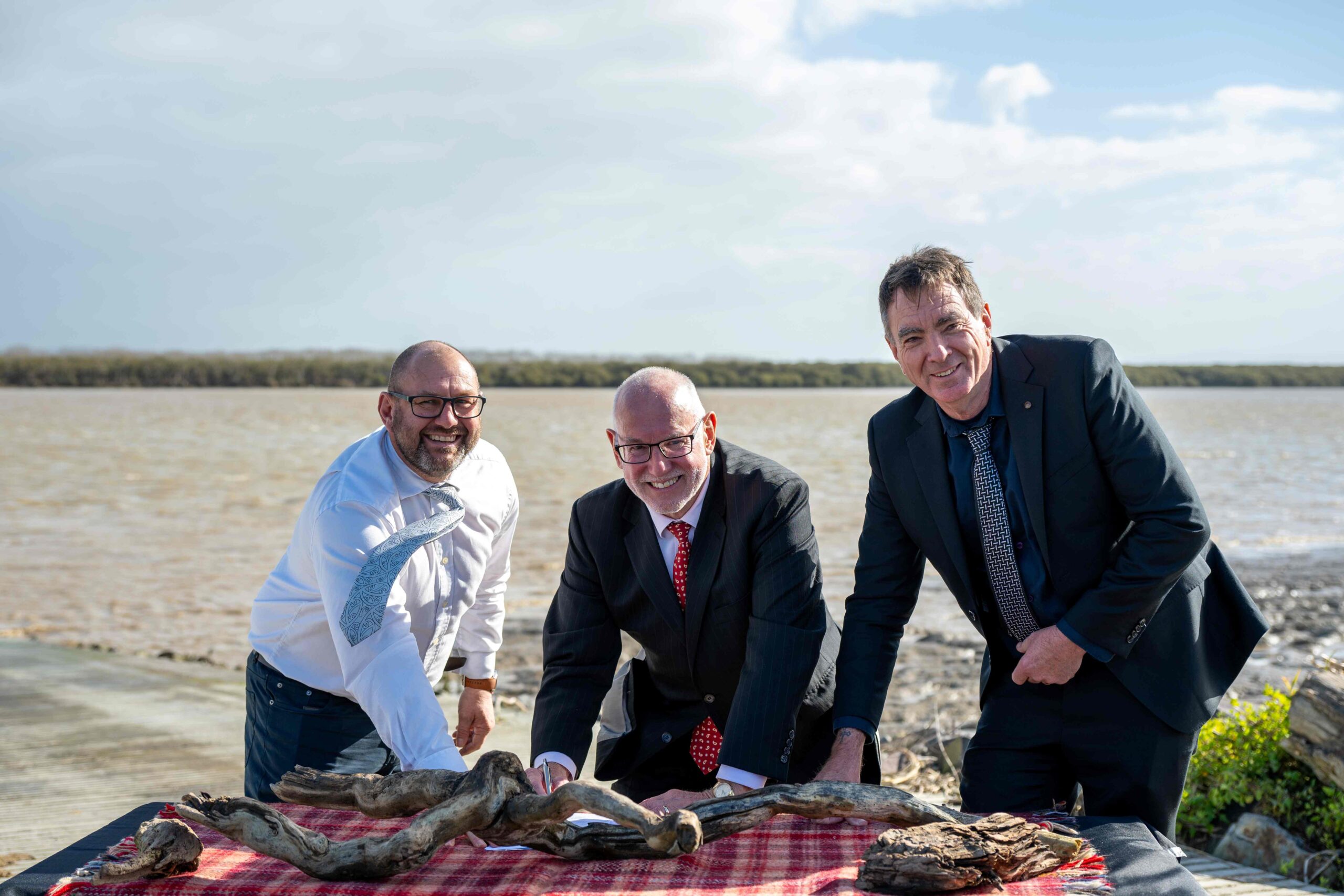
The three Mayors – Peter Revell, Toby Adams, and Ash Tanner – signed a Memorandum of Understanding on August 4, after each held meetings with their respective councils to approve the proposal.
Mayor Adams said the proposal was a strong one, with the three councils having a history of working well together.
“These are generational decisions that we’re making,” he said.
“Our public gave us very good start that they wanted an eastern catchment of some sort…they didn’t want to be sucked up into a large area and lose that local voice.”
Hauraki Deputy Mayor Paul Milner agreed.
“The biggest benefit to this option is smaller rural towns and communities that fit well together… being too big would not suit us well.”
Matamata Piako Mayor Ash Tanner was also confident.
“I think if any grouping’s going to work, it’ll be this one,” he said.
The decision wasn’t as straight-forward for Thames-Coromandel, with four councillors voting against submitting a proposal at all. Others were disappointed that a merger with Bay of Plenty councils was not on the table.
Deputy Mayor John Grant said the chosen option lacked some of the scale and coastal connections offered by a Bay of Plenty grouping, although it did bring together long-standing neighbours who had seen TCDC at its best and stood by it through its worst.
“Our Bay of Plenty cousins could not bring themselves to open the door wide enough to invite us through – and the option had genuine appeal: more scale, continuous coastal catchment, and an exciting Bay tourism story with the Coromandel as the gem in the crown. But you cannot walk through a door that is not open for you,” he said.
“Once you look past what we did not get, the case of what we did get is strong.”
All three councils were united on their criticism of the speed at which councils were expected to make their decisions.
“None of us stood to be elected last year on the fact that we were going to be reforming local government,” Mayor Peter Revell said.
“We are doing something that we weren’t expecting to be doing, and probably something that we wouldn’t have chosen to do if we’d had that opportunity.”
“[We’re] happy with being able to put in a proposal, not happy with the government imposing it on us,” Mayor Tanner said.
“When you talk to your communities, they say ‘why are we doing this, fight it, tell them to get stuffed’, [but] putting nothing in, that’s not really an option because then you’re in a backstop and with not knowing what the backstop is, there’s too many unknowns.”
Mayor Adams was similarly pragmatic.
“In some respects it was frustrating because it was so time pressured but in other respects we had to get to a decision and get to it quickly… So yeah, it’s a 50-50 for us,” he said.
“I think we’ve signalled clearly that some of [the government’s] decisions that they’ve made of late have felt quite rushed and aren’t very democratic in our view but hey, we’ve just got to run with it.”
Meanwhile, Waikato District Council unanimously voted to adopt a Western Waikato Unitary Authority proposal, which would also include South Waikato and Waipā District Councils.
The Western Bay of Plenty District Council chose not to participate in the Head Start pathway, although it has still been listed as a potential partner in Tauranga City Council’s proposal submission.
Councils that haven’t submitted a proposal are now subject to the government’s “backstop” process – a compulsory restructure with the specifics yet to be decided.