LOVE YOUR HOME FEATURE Everything in John and Linley’s garden is where it should be. Plants sit with purpose, art pieces hold their posture and articles of furniture take up space with intent. I stand between two garden areas in front of the historic Ohinemuri Lodge in Paeroa, John Eaglen and Linley Rose’s abode, and cannot take my eyes off the red maple trees. The building was transformed into their place of living, and the gardens, a place to find peace. As I face the building, I look to my left and there’s the Garden of Reason, and to my right I see a mirror image in the Garden of Wisdom. It’s hard to tell when I look at the lush layers before me, but it wasn’t anything like it at all before the owners took possession in June, 2021. “There was nothing when we came, it was just a cocoon,” they told The Profile. Trees with leaves dipped in deep red, some heavy-laden, stand with elegance and grace. A red bench invites a peruser to rest at both ends of the gardens. Rows of greenery stand along the front fence line followed by a looped path area for people to meander, a centre strip of green with red maples in bloom and another row of greenery along the back.
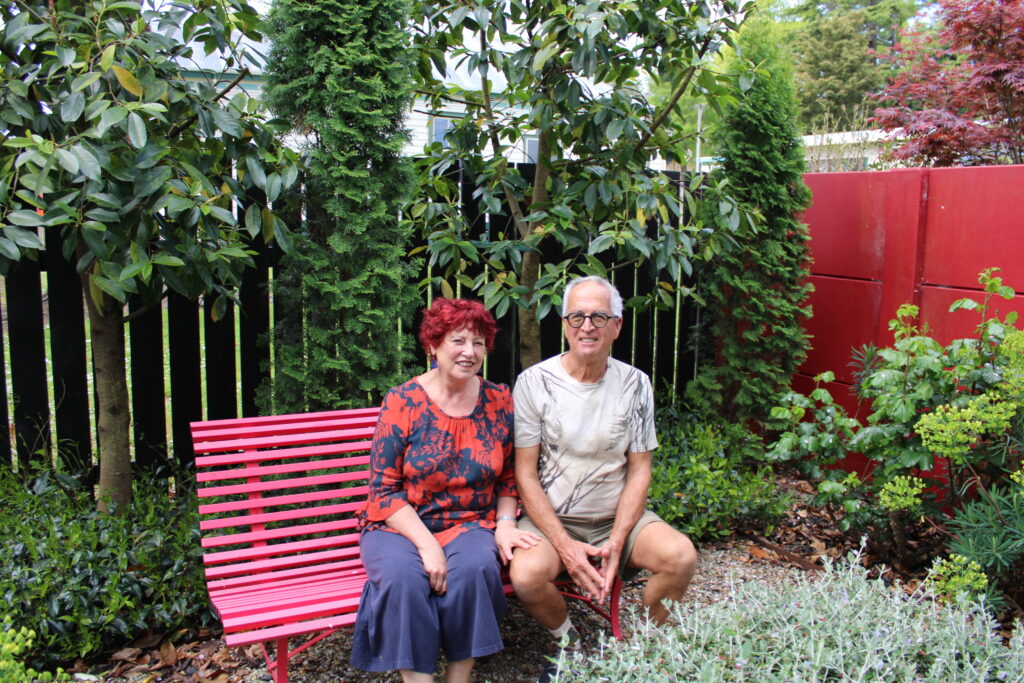
Linley and John in the Garden of Reason.
Photo: DAVIDDA HIKATANGATA
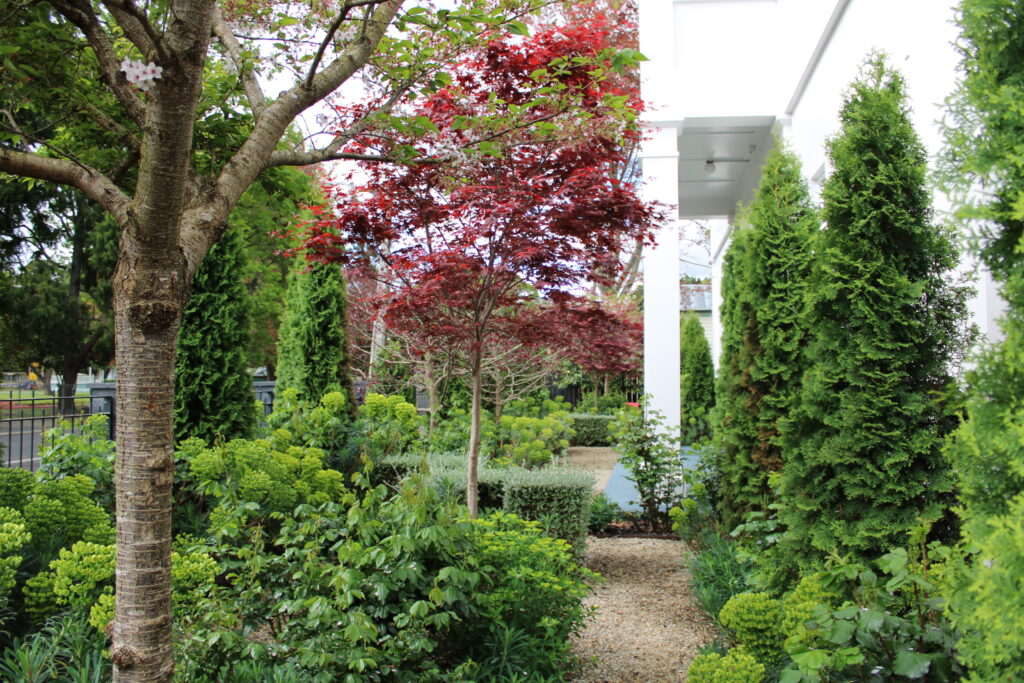
“[We’ve] got whitish roses at the front and in the middle, and then red roses against the [back].” Everything tells a story and has a purpose. The tall green trees known as Thuja Occidentalis Pyramidalis were placed to add formality and “echo” the columns of the building. “These two sides, [the] front garden, [are] very much responding to the building itself and its history as the Masonic Lodge, you know, something with solidity and rationality,” John said. “We did employ another designer as well to work with us on this because we felt it was high profile and important to get it right,” Linley said. The visionary pair, who come from art and design backgrounds, make visions come to life. John built sets for operas and plays, including Mozart’s opera Magic Flute a couple of times. He tells me Mozart was a mason. “In the Magic Flute, there are three temples – Wisdom, Reason and Nature. So these [are the] three gardens around here, the Garden of Reason, the Garden of Wisdom and the Garden of Nature around the corner.”
The Garden of Wisdom leads to the Garden of Reason.
Photo: DAVIDDA HIKATANGATA
“We will at some stage put down some suitable art pieces in Wisdom and Reason. And we have determined that because the masons wouldn’t allow women, at the time this was built, into their lodge, our Wisdom figure will be a female figure. Possibly both, but at least one.” The curators lead me around the corner to the Garden of Nature. A path weaves through a sea of greenery. “The rest of the gardens we’ve pretty much got organised, [but this is] one of the last ones for this spring clean-up after winter. Gardens take quite a lot of work after winter to get them looking good for the spring.” A moa made of corten steel stands in the sea of green, an art piece made by John. Cheerful yellow buds greet me as they hang down from branches. “This was quite a brave thing to plant about 10 kowhai. We lost a big one there last year. They’re just about finished flowering, but they’ve been lovely,” Linley said. “And we’ve had our first tūī this year.” A sea of ringa ringa plants surround us. “I potted up 400 of them during Covid so that’s where they came from,” Linley said. The frost did quite a lot of damage to some plants so John and Linley had to cut away a lot of it. I wander through to the back of the property, where there is an edible garden, though the duo tell me it’s mostly operational in summer. “We’re not great vegetable gardeners, so we only have a summer garden. We fail in the vegetable garden department.” I mosey past the vegetable patch and step into another world. My eyes don’t know where to lay, they scan in awe because there’s something pleasant to admire in all directions of the duo’s outdoor living area which is inspired by Japanese-based style.
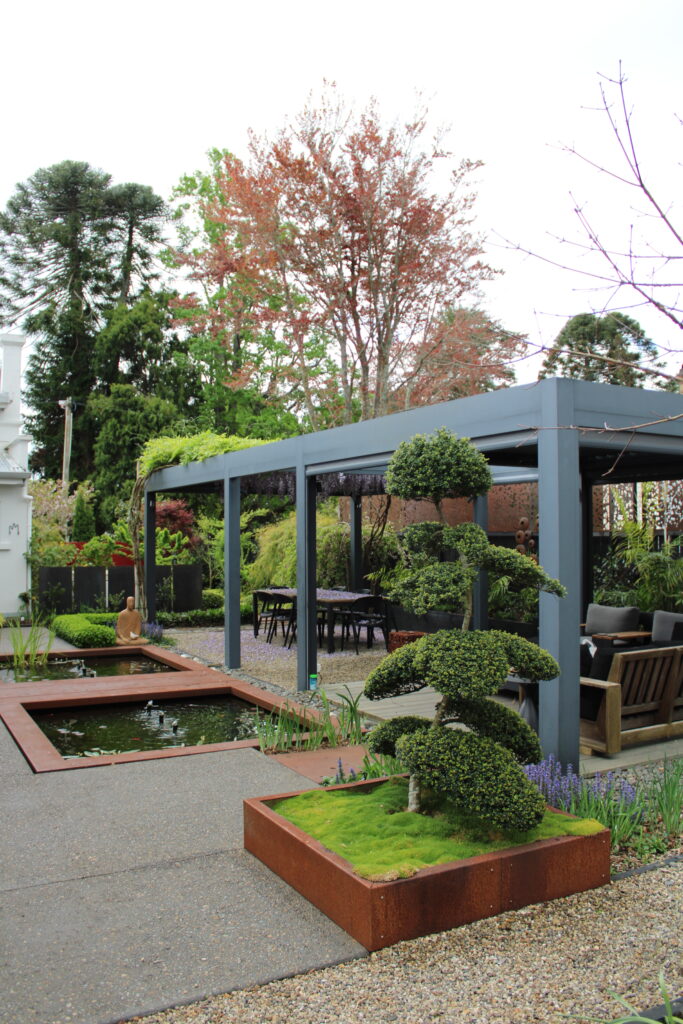
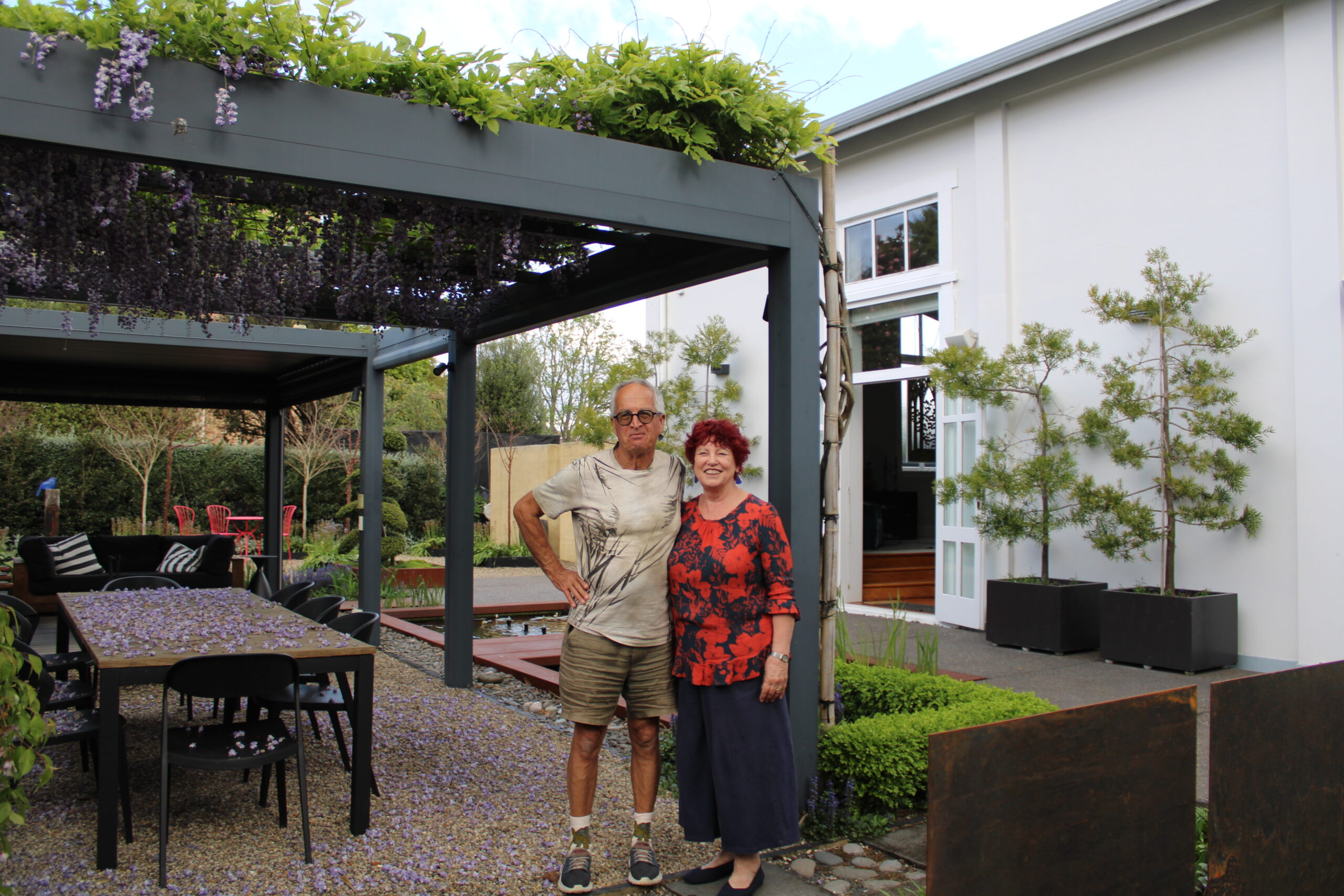
There’s something interesting to look at in every direction. Photo: DAVIDDA HIKATANGATA
There’s an avenue of trees to my right, an area for alfresco dining and relaxation underneath the pergola in the middle, and a bridge that leads over a fish pond. Tucked away in the far corner is the Japanese Garden of Contemplation. But my attention is held by the wisteria that rests over the pergola. “All the flowers dripping on the table is quite gorgeous,” Linley said. Polite petals cascade on to the table below as if mother nature herself sets the table. The chairs and ground are also recipients of the pastel purple pretty. John and Linley said they had a Japanese garden specialist share advice with them about Japanese style pruning. “But mostly we get that from books and from being in Japan because we visited Japan a couple of times. That’s how they would have the wisteria looking in Japan and we’re pretty chuffed with how that looks. This is our first Japanese garden, but we’ve done lots of gardens and worked with lots of designers.” The creative pair said they liked to collaborate with people and other professionals. “We don’t know everything and bouncing off ideas and things from other people is always useful and then you come up with a fabulous solution instead of just a good solution.” Irises and camellias layer the space between the avenue and alfresco dining areas. “Layering in the garden is quite important for what we’re trying to achieve.”
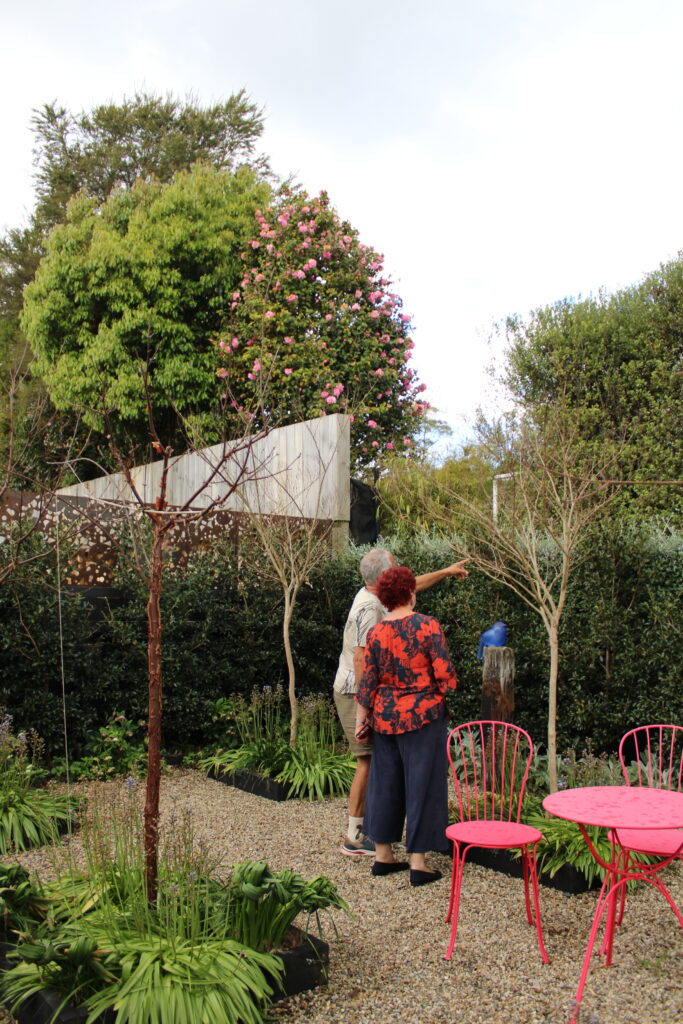
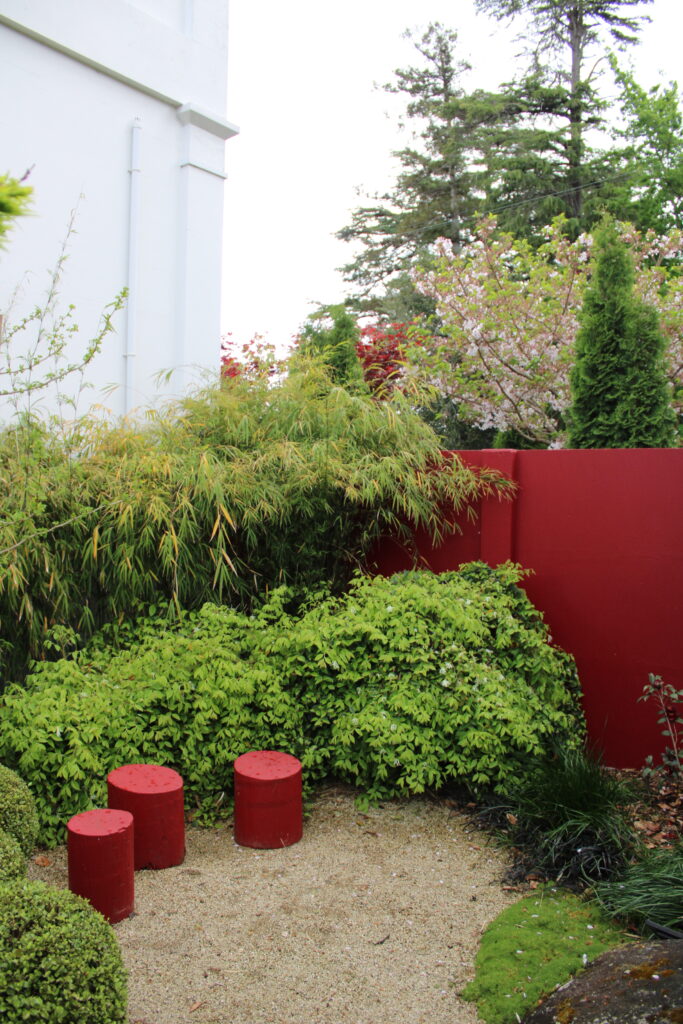
The colour red is an important one.
Photo: DAVIDDA HIKATANGATA
It is a “high-intensity garden”. “I mean, it’s small [but] there’s a lot of plants, and they need to be quite carefully managed otherwise, it would just go wild and it would lose its structure very easily.” I watch the goldfish swim as I saunter past to the garden of contemplation. “You’re able to come down here and just be peaceful,” Linley said. The colour red is an important one, it marks out some of the spots to rest such as the dining table and chairs in the avenue and also three log seats in the contemplation space. My feet follow the rock path back to the living area and my eyes rest on the corten steel art pieces that line the top of the fence. “Rather than make the wooden fence higher, we’ve used it as a way of using John’s art.”
Japanese Garden of Contemplation.
Photo: DAVIDDA HIKATANGATA
As I walk beneath the pergola, it looks like the sky hands me grapes through the gaps in the top. “With this being a historic home, we’re limited to what we can put on the outside, so we couldn’t attach a veranda to the outside. We had limitations to work within that,” Linley said. “But as usual with limitations, they just help shape the design solution. To design without any limitations is a very difficult thing to do,” John added. Their passion and gratitude for the garden is unmistakable. “Just in the last month with the blossoms and the wisteria and seeing everything come alive is just fabulous. But then in November, when the roses are in full bloom, that’s glorious.” It was also a highlight when the rain lilies would flower through the summer with the slightest little rain shower, they said, and then also the being able to eat from their vegetable garden in January, February and March. For the innovative duo, “every time of year is beautiful” in their garden, they said. “We knew what we wanted, and that’s what we did.” By DAVIDDA HIKATANGATA
Beautiful gardens transform the historic Ohinemuri Lodge.
Photo: DAVIDDA HIKATANGATA