A Pūriri landowner concerned about flooding is seeking answers about who’s responsible for clearing debris in the river adjacent to his property.
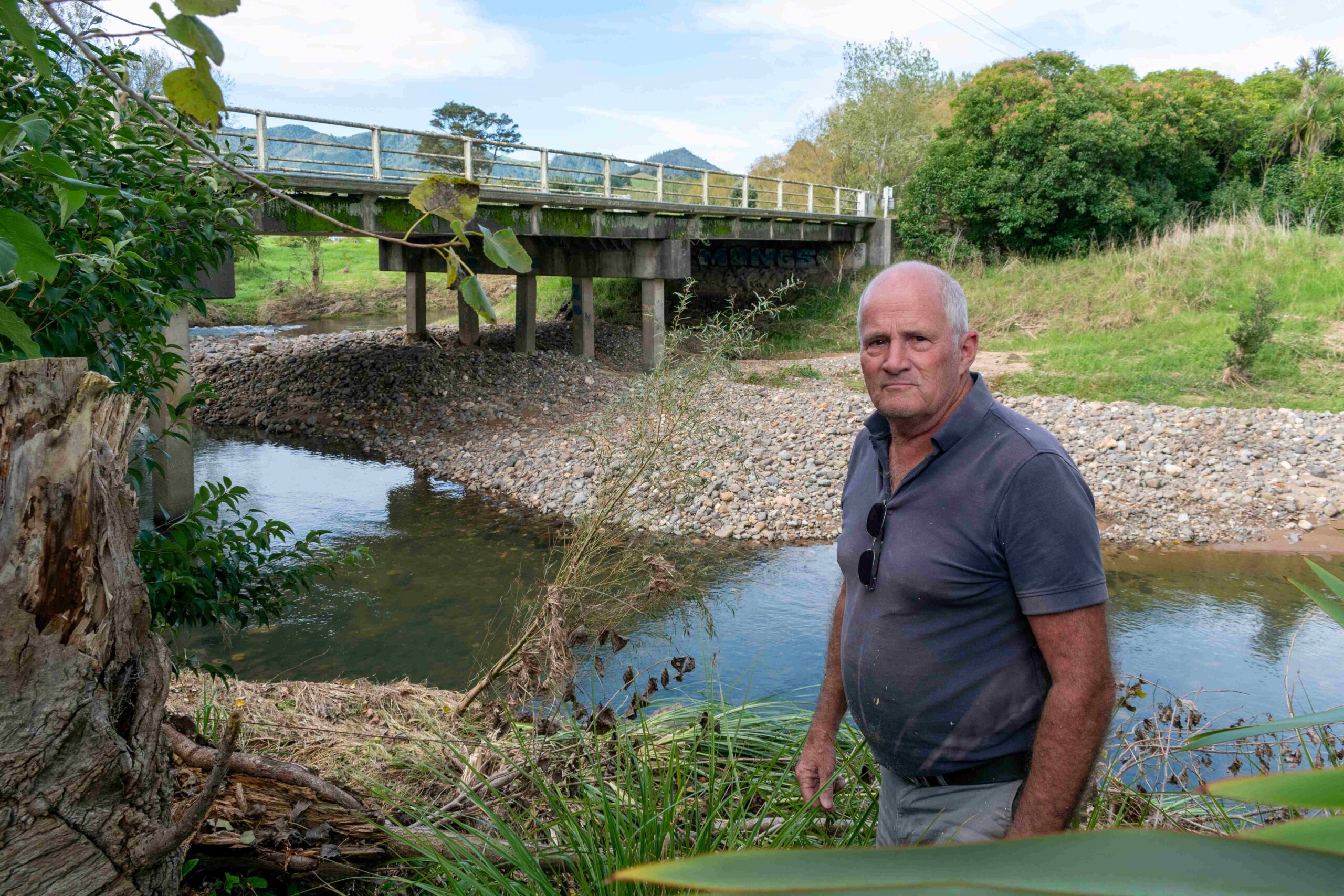
Geoff Doman has lived on his low-lying Thames Valley property for around six years. It’s bordered on one side by the Pūriri River, which passes under a nearby bridge on State Highway 26.
Geoff’s concern is a roughly two-metre-high, 40-metre-long pile of gravel and other debris which has settled underneath the bridge and along part of the length of his property. Geoff said the build-up is putting the river at an increased risk of flooding – during Cyclone Vaiau in April, he said the river was threatening to burst its banks.
Geoff’s property has flooded once before, during Cyclone Gabrielle in 2023. Geoff remembered fleeing in the middle of the night, after floodwaters reached 450mm high inside his shed and caravan.
“I woke up at 2.30 in the morning in the caravan – I put my feet out and hit water,” he said.
“Luckily I had my ute facing [the road] and I knew roughly where the driveway was, so I got out okay.”
Geoff said he had been trying to get the latest pile of debris cleared for more than 18 months – he is not allowed to do it himself, he said, nor could he afford to do so.
But both Waka Kotahi NZ Transport Authority (NZTA) and the Waikato Regional Council (WRC) have told him it’s not their responsibility. An email from NZTA to Geoff last year stated “NZTA’s role is limited to maintaining the bridge structure itself… broader river management, including sediment and gravel build-up within the channel, sits with Waikato Regional Council.”
Meanwhile, emails between Geoff and various WRC representatives have said “works to repair degradation or remove aggregation under the Pūriri bridge [is NZTA’s] responsibility”.
Both agencies have inspected the site in person. Following Cyclone Gabrielle, WRC carried out some remedial works, including clearing debris, removing fallen trees, widening and deepening the water channel, and building up the bank alongside Geoff’s property.
This work was done with NZTA’s approval and used central government funding, council told The Profile.
“The landowner has acknowledged these works improved waterway capacity and reduced flood impacts,” a council spokesperson said.
“No further works are planned unless NZTA identifies a risk to the bridge asset. Council’s role in future works would be limited to providing regulatory advice if a private landowner seeks to undertake works.”
The council said Geoff’s property sat outside the direct benefit flood protection area of the Waihōu Valley Scheme and was therefore rated as a Classification D property.
“There is no rating or level of service for flood protection or channel capacity works at this site, and the works requested by the landowner fall outside council’s responsibilities.”
NZTA similarly said it had no current plan to undertake further works at the site.
“The most recent inspection found the bridge to be structurally sound. While the build-up of material beneath the bridge was not assessed as a structural threat or to be adversely impacting the upstream environment at that time, NZTA has asked its contractor to complete an updated inspection to confirm the current condition and identify whether anything has changed. NZTA will consider any further action if the updated inspection identifies a risk to the bridge or the state highway asset.”
Both organisations consider all their decisions to date to be compliant with the relevant rules and responsibilities.
Meanwhile, Geoff said he would continue fighting for someone to remove the debris as he believed the stream’s current state was affecting his health.
“I cannot get into bed of a night time without putting my head on the pillow and it comes up straight away every single night now, so I’ve got to try and concentrate and think of something else so I can get to sleep. It’s just affecting me that much,” Geoff said.
“The doctor said, ‘you’re going to have to have a pacemaker’. So I ended up having to have this bloody thing in here… I just don’t need this stress.
“I know there’s so many more people that are worse off than what I am. But this has been going on for so long, and they’ve had the opportunity to be able to do it. But they just refuse to do it.”