Waiomu man Richard Simpson knows he is lucky to be alive after getting stranded in the Coromandel forest in inclement weather, with limited supplies.
Now mostly recovered from his ordeal, he has been left with a deep sense of gratitude for the many people involved in his rescue – along with stern instructions from his son to “[not] go into the bloody bush again, Dad”.
Richard’s December 28 adventure began innocently enough.
It was a sunny, clear morning, and he decided to walk from his home up to the Waiomu Kauri Grove.
“Then I thought, oh, what a lovely day. I’ll just move on a little bit further.”
A bit further became a bit further still until Richard, who was clad only in a t-shirt, shorts and track shoes, found himself climbing over root systems and delving further along the Waiomu Valley Track, a steep and difficult track with an elevation gain of more than 700 metres.
With the day mostly gone and the weather turning, Richard eventually decided it would be safer to continue on to Crosbies Hut, which is around 10km from his starting point.
By now, he had finished the water, banana, and handful of bickies he had brought along.
He was also thoroughly soaked through from rain, and bleeding from a gash in his arm.
“I sort of curled up in an area and phoned my son, who lives in Tauranga, and told [him] the position I was in and to ring the police,” Richard told The Profile.
“I was getting very cold at that stage and started to shiver.”
It was now 10pm. While a policewoman stayed on the line with Richard, a lot was happening behind the scenes.
A helicopter was sent to pinpoint his position, which turned out to be only 100 metres from Crosbies Hut.
Although the weather stopped the helicopter from landing, it was able to keep a spotlight trained on Richard from above.
Meanwhile, two Land Search and Rescue (LandSAR) teams had been deployed, one from Thames and one from Waihī.
Police had also managed to contact a family who were staying in the hut overnight, and asked them to join the search.
“A slight young woman and her 14-year-old-daughter came down [from the hut]… they were trampers from Wellington,” Richard said.
“They brought me down a large plastic sheet to try and keep me as warm as possible.”
The women helped Richard navigate the steep incline up to the hut, Richard pulling himself along on his hands and knees.
When they reached the building, they stripped Richard down to his underwear, set him in front of a fire, and helped him clean up his by-now numerous wounds and gashes.
“My clothes and shoes were just filthy… they dried me off the best that they could,” Richard said.
“They had hired Crosbies Hut for [just] that particular day. Now wasn’t I lucky that they were there?”
Several hours later, the Thames LandSAR crew arrived at the hut with clean clothes and provisions after walking in on foot.
“They were so well equipped, I just couldn’t believe it. And radio contact all the time with their teams. I was highly impressed,” Richard said.
“It was decided in the morning that we would attempt to walk out.”
Richard and his rescuers farewelled to the other trampers and began the trek.
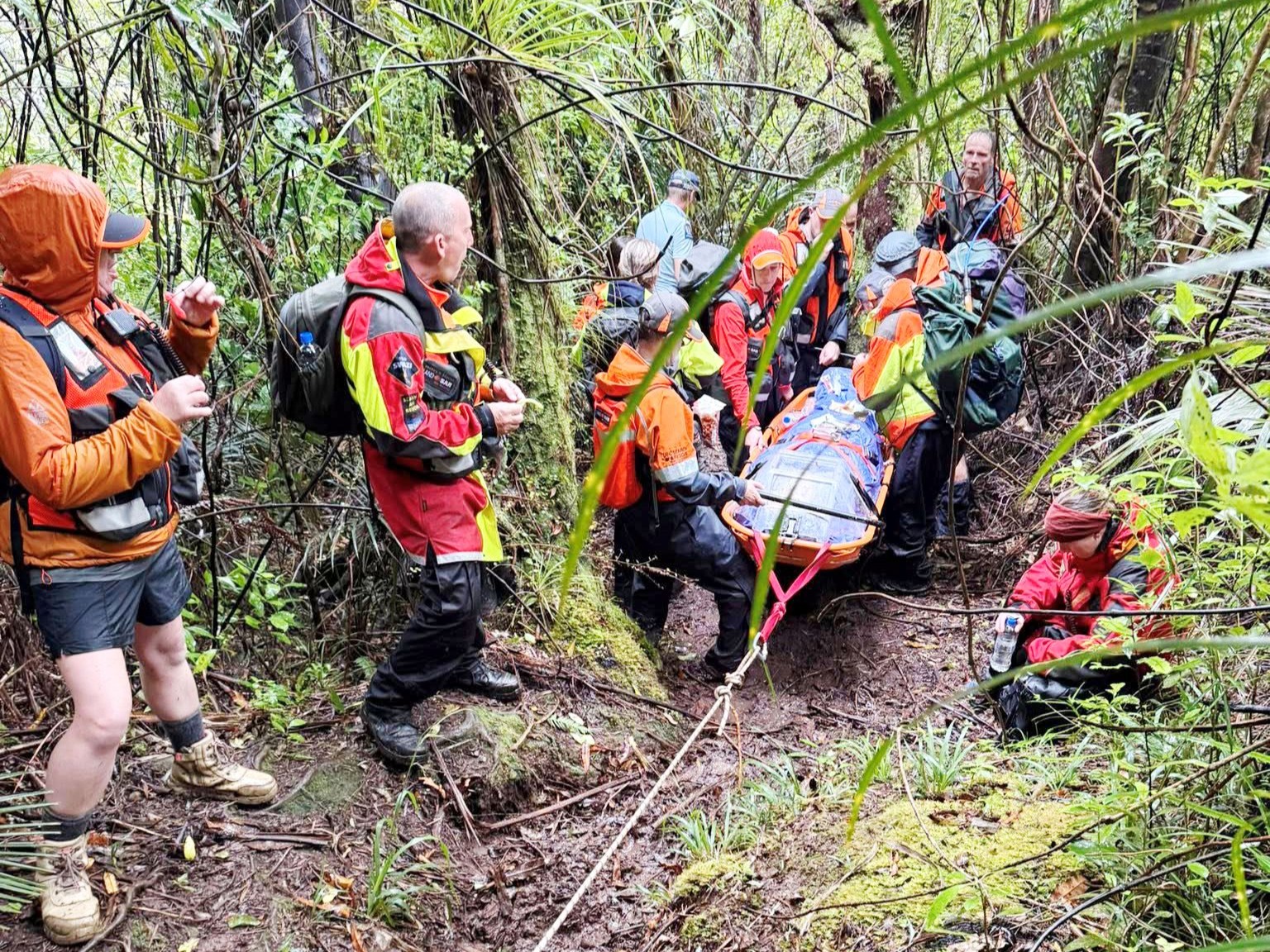
“After a period of time the Waihī LandSAR team came into view. And they brought in a stretcher they called a mule,” Richard said.
“I was tied into that so I was secure – some of the terrain was so steep. It was really quite a cool thing. [The team] was like an orchestra – left, right, you could hear somebody in the front guiding.”
The rescue team eventually decided to retrace their steps to a clearing, where a helicopter would be waiting.
Richard was winched up into the helicopter by harness with another member of the rescue team.
He arrived at Thames Hospital around 9pm – some 36 hours after setting out on his stroll.
Bloodied, bruised, and dehydrated, Richard spent the next day on a drip.
Several weeks later, Richard has mostly recovered from his ordeal. But he’s pragmatic about the experience, and knows just how lucky he was.
“If I didn’t have my phone, I would have died, there’s no two ways about it,” he said.
“I shouldn’t have gone that far – that was my fault, dawdling along in the sunshine. And the equipment I took was really for going to the beach, not for getting into the situation that I got myself into.”
Police Inspector Mike Henwood said the rescue was an uncomfortably close call, and a reminder to hikers to be prepared for any eventuality.
“[Richard] was very close to not being able to continue, and if it weren’t for the family staying at the hut nearby, things could have been very different,” the inspector said in a press release.
“It’s important to wear appropriate clothing and take food and water even for a short walk – especially if you’re not sure of the area. Emergency Locator Beacons are cheap to hire, and they’re capable of saving your life, even when there’s no cell phone reception.”
As for his rescuers, Richard has nothing but effusive praise. And he is still in touch with the family from Wellington, who have asked not to be identified.
“The way the police handled it and the search and rescue guys was just commendable. I was more than impressed,” Richard said.
“And the family from Wellington, who were first on the job, were again to be commended. I was treated well everywhere, by everybody. Even in the hospital, I was well attended and well looked after… We’re very lucky we’ve got services like this.”